
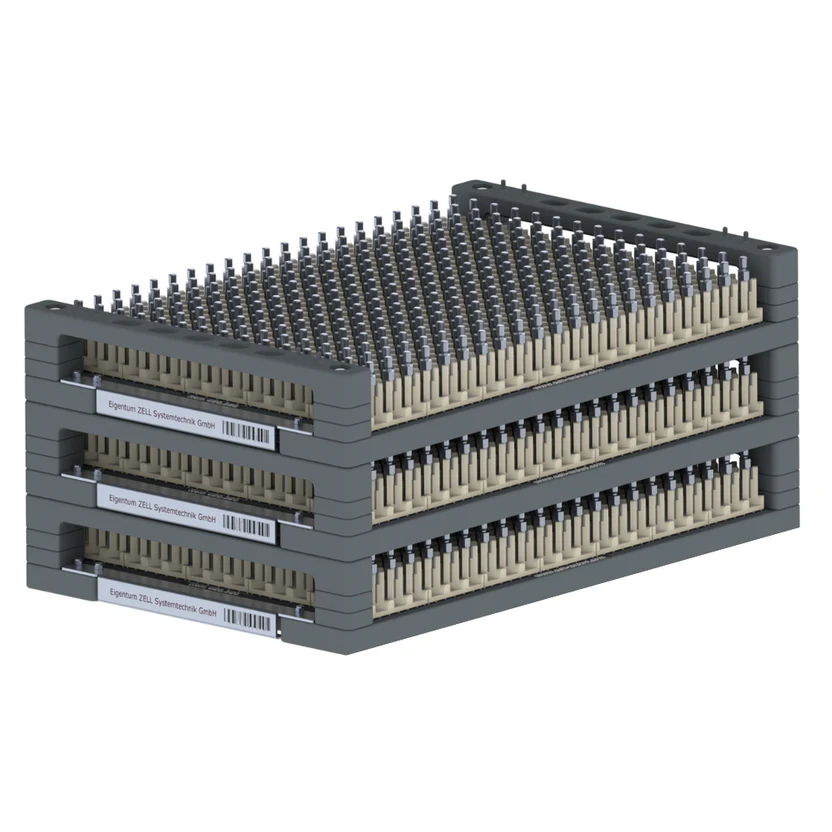
Defined cavities on trays enable fast and precise picking processes. Precision components can thus be optimally handled, processed, and assembled in batches.
Send your request


Modular trays, standardized with a defined matrix. Adjustable in less than three minutes.
Compatible with QR or barcodes, RFID, and Auto-ID systems. Adaptable to existing automation systems.
Precise placement in protective plastic clips, optimally positioned for grippers and handling systems.
%20(2).webp)
ZELL systems are used wherever components need to be automatically handled, positioned, and transported – for example:
Cost Factor: Time
Automated production works best when the same component is always located in exactly the same position. This simple indexing within a defined matrix saves significant time—especially across multiple production steps.
If an industrial robot had to perform “bin picking” at every production stage because components are supplied in a semi-structured or chaotic manner, three steps would always be required:
Detect and analyze the structure of the parts using a vision system and identify the position of each individual component.
Transfer the image-processing data to the robot controller and calculate the optimal path, gripping, and extraction strategy.
Place the component at a predefined position or transfer it to the next production step.
No matter how powerful the computing performance, this process takes time. It therefore makes sense to complete this step at most once—and then consistently present the automation system with the same structured component layout. That is Lean Production.
Cost Factor: Money
In production, time equals money. But there is another decisive factor: scrap. Producing lower-quality parts (B- or C-grade goods) creates direct financial losses. If a manufactured component cannot be assembled or sold, the company must book a loss—contradicting the principles of successful lean production.
With a custom tray system, components are not only secured but also transported gently throughout the entire process chain. Especially when using individual component holders (clips or multi-clips), physical contact between parts is virtually eliminated. As a result, surface quality is preserved until the final stage of production.

Manufacturers of precision and small parts with automated production processes can transport components either in bulk within containers or individually. Thanks to their clearly defined placement matrix, precision trays offer significant advantages for automation.
Production companies typically begin by transporting parts in low-cost boxes. However, these are difficult to integrate into automated processes. While a worker can easily pick a part from a box, for a robot “bin picking” is a highly computation-intensive task. Ongoing advances in camera technology, sensor systems, and software have already led to effective solutions for separating parts from containers. Nevertheless, each of these methods remains slower than the clearly defined, single-piece feeding of components in a parts carrier.
Trays with compartments enable efficient handling of larger batches of parts. As automation processes become more complex, the next step often involves complete singulation of the components. These are then typically handled directly within the production line or machine.

If defined placement positions already exist—for example through blister trays into which parts must be re-batched—it is generally necessary to develop equivalent custom trays. The same applies to existing automation processes. If, for instance, an industrial robot has already been programmed for a specific handling method, it may be more cost-effective to adapt the tray to these conditions rather than reprogram the automation system.
In cases where specific external dimensions are required that cannot be configured using ZELL standard components, a custom stainless steel tray must be manufactured to meet the corresponding specifications. In such cases, development costs are significantly lower compared to plastic solutions, while the material costs are correspondingly higher.
Therefore it is common practice, that for customized solutions manufacturers are using tailored stainless steel trays combined with plastic inserts or clips to ensure optimal process reliability and efficiency.


Immer wieder gibt es auch individuelle Anfragen von Kunden. So hat ZELL auch schon passend auf die bestehende Reinigungsanlage entwickelt. Über eingearbeitete Blechelemente können so einzelne Trägerbleche flexibel in der Höhe eingelegt werden. Damit lässt sich ein großes Teilespektrum ohne aufwendige Umbaumaßnahmen abdecken. Das Korbmaterial besteht aus V2A, 1.4301 mit elektropolierten Oberflächen. Reinigungskörbe in dieser Form eignen sich für Industrien mit sehr großen Bauteilen, die in ihrer Form variieren.
Mehr zu unseren Reinigungskörben für große Bauteile
Verbesserte Sicherheit
Standardisierte Reinigungskörbe verfügen über Sicherheitsmerkmale wie Griffe, Verriegelungsmechanismen und ergonomische Designs. Diese Merkmale erleichtern das sichere Handling, den Transport und das Be- und Entladen von Teilen, sowohl in automatisierten Prozessen als auch manuell. Darüber hinaus werden standardisierte Körbe umfangreichen Tests unterzogen, um die Einhaltung relevanter Sicherheitsstandards zu gewährleisten und das Risiko von Unfällen oder Verletzungen während des Reinigungsprozesses zu minimieren.
Kostenersparnis
Standardisierte Reinigungskörbe bieten Kostenvorteile im Vergleich zu individuellen Lösungen. Aufgrund ihres standardisierten Designs können sie in größeren Mengen auf Lager produziert werden. Dies führt in der Regel zu niedrigeren Stückkosten und bietet insbesondere Kunden mit großen Produktionsserien eine günstigere Alternative.
Eindeutige Identifikation aller zu waschenden Teile
Reinigungskörbe von ZELL können Optional mt Kennzeichnungshaltern bestellt werden. An diese lassen sich RFID-Chips anbringen, bzw. Bar- oder QR-Codes einlasern. Diese ermöglichen die Eindeutige Identifikation von Teilen während des gesamten Reinigungsprozesses in Echtzeit und tragen so direkt zum Qualitätsmanagement bei.
Nachhaltige Wartungsmöglichkeiten
Darüber hinaus vereinfacht das standardisierte Design modularer Reinigungskörbe die Wartungs- und Reparaturverfahren, da einzelne Ersatzteile oder Komponenten leicht verfügbar und austauschbar sind. Damit sind die Körbe von ZELL auch eine nachhaltige Alternative zu bestehenden Korbsystemen.
Our systems can be equipped with RFID, DMC, or laser codes – enabling complete component traceability and seamless integration into MES and ERP systems.
The modular design of ZELL systems ensures consistent indexing of the entire custom tray assembly. Since a matching tray and basket exist for every clip, the position of each individual component remains traceable and calculable for all machines and industrial robots, even throughout complex process steps.
For example, if a turned part is manufactured on a CNC machine, measured, and placed onto a tray, then inserted into the corresponding basket and washed as a complete batch, the exact position of each individual part can still be identified afterward.
Each custom tray and basket can be uniquely identified via an attached labeling holder with a QR code or RFID chip.
Many customers already work with automation partners who can fully integrate these systems. Together with partners such as TURCK, we also provide complete project planning and implementation support.


.png)


